Lenovo Showcases Futuristic Laptop and AI PC Concepts at MWC 2026 Including Go Fold, ThinkBook Modular, and Yoga Book Pro 3D
IIE DIGITAL DESK : The Mobile World Congress (MWC) 2026 in Barcelona, global technology giant Lenovo unveiled an ambitious vision for the future of personal computing with multiple concept devices that blend cutting-edge design, modular flexibility, immersive experiences, and advanced AI integration There were several standout showcases ranging from foldable gaming hardware to modular and 3D laptop concepts that together highlight Lenovo’s direction in the evolving PC landscape .
One of the most eye-catching concepts was the Lenovo Legion Go Fold, a foldable gaming handheld device with potential to redefine portable play and productivity The Legion Go Fold concept features a foldable POLED screen that expands from around 7 7 inches to approximately 11 6 inches when unfolded and supports multiple usage modes beyond traditional handheld gaming With detachable controllers, split-screen multitasking, and desktop-style interaction support, the device is envisioned as more than just a gaming console but a hybrid PC capable of handling productivity tasks and entertainment alike The concept is powered by an Intel Ultra line processor, paired with 32 GB of RAM and 1 TB of storage, although it remains a prototype rather than a confirmed commercial product at this time .
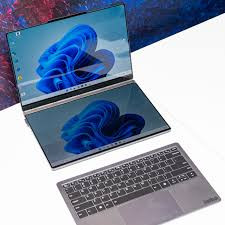
Alongside the flexible gaming hardware, Lenovo also displayed the ThinkBook Modular AI PC Concept, targeting professionals and creators who demand versatility from their machines This modular concept laptop sports a 14-inch main display and supports interchangeable ports and components, allowing users to customize inputs like USB-C, USB-A and HDMI depending on need beyond what traditional laptops offer Unlike fixed-configuration devices, the modular PC base can accommodate removable elements to adapt to different tasks Users can even attach a secondary 14-inch touch screen magnetically or repurpose it as a portable monitor for expanded productivity The concept also supports swapping out the keyboard or choosing alternative input components, suggesting a future where laptops evolve based on user workflow rather than static design .
Perhaps the most imaginative innovation Lenovo put on display was the Yoga Book Pro 3D Concept, a glasses-free 3D laptop aimed at content creators and designers Combining dual Lenovo PureSight Pro Tandem OLED displays with AI-powered 2D-to-3D conversion, the Yoga Book Pro 3D enables users to view depth and manipulate 3D elements without additional headgear or peripherals Creative professionals can interact with on-screen objects using gesture controls supported by onboard RGB cameras and magnetic “snap-on pads” that trigger app shortcuts This amalgamation of immersive visuals, intuitive controls, and advanced graphics processing hints at how spatial computing might redefine creative workflows beyond flat displays .
All of these concepts at MWC 2026 also tie into Lenovo’s broader AI ambitions, including the rollout of Lenovo Qira, a personal ambient intelligence assistant integrated at the system level across the company’s devices Qira will be deployed across more than 20 PCs, tablets, smartphones and wearables and is designed to help maintain continuity across tasks and seamlessly assist users based on intent rather than isolated applications This AI framework reflects a shift toward more adaptive and intuitive computing experiences that bridge devices and workflows in everyday life .
While none of the showcased devices are confirmed for immediate commercial release, the breadth of Lenovo’s concepts signals where the industry could be headed in the near future Foldable screens, interchangeable hardware, and immersive 3D interfaces suggest a future where computing devices are more adaptable, more personal and far more integrated with user needs than traditional laptops and PCs.
You might also like!