A Village Where Rath Yatra Celebrates Lord Balabhadra in a Unique Tradition
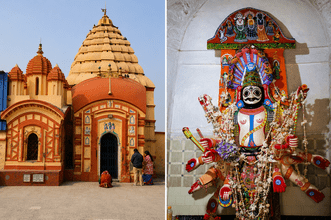
IIE DIGITAL: For most of the devotees, Rath Yatra is inseparable from Lord Jagannath. Every year, grand processions, towering chariots, and chants of "Jai Jagannath" fill the streets across India, with Lord Jagannath at the centre of the celebrations. Although Lord Balabhadra and Goddess Subhadra accompany Him on the sacred journey, they often remain in His shadow.
Yet, tucked away in Boro village of Raina in Purba Bardhaman, a remarkable tradition offers an entirely different perspective on the festival. Here, it is Lord Balabhadra who occupies the highest place of reverence. The centuries old Boro Balaram Temple is one of the very few shrines in Bengal where Lord Balabhadra is worshipped as the principal deity, making it a destination of immense religious, historical, and cultural significance.
A Village Named After Its Deity
The
influence of Lord Balabhadra extends far beyond the temple walls. The deity is
so deeply woven into the identity of the village that the area itself is
popularly known as Boro Balaram.
For
generations, the temple has remained the spiritual heart of the community.
Local customs, agricultural traditions, and annual festivals continue to
revolve around the presiding deity, reflecting a bond that has remained
unchanged for centuries.
Unlike the familiar worship of the Jagannath trio, where Lord Jagannath occupies the central position, this temple honours Lord Balabhadra independently, highlighting His importance as a symbol of strength, protection, and prosperity.
An Extraordinary Idol with
Powerful Symbolism
The
temple's most remarkable feature is its magnificent wooden idol of Lord
Balabhadra, which stands nearly 14 feet tall and immediately commands
attention.
The deity
is portrayed with fourteen arms, an unusual representation believed to
symbolise limitless divine power and the ability to protect devotees from every
direction.
Above His
head rises a magnificent thirteen hooded serpent canopy, a sacred symbol
associated with divine guardianship and cosmic protection.
Another
striking aspect of the idol is its three eyes, representing the Sun, the
Moon, and Fire. Together, these elements symbolise wisdom, energy, and eternal
vigilance.
True to His identity as the deity of farming communities, Lord Balabhadra carries a plough in one of His hands. This ancient agricultural implement reflects His association with cultivation, fertility, and the prosperity of the land, explaining why farming communities across the region continue to hold Him in special reverence.
A Temple with Centuries of
History
Although
historians have not been able to establish the exact date of construction, the
temple is believed to be nearly seven centuries old.
Its
historical significance is reinforced by references found in celebrated
medieval Bengali literary works, including Mukundaram Chakrabarti's Chandi
Mangal and Maladhar Basu's Sri Krishna Vijay, suggesting that the
temple has been an important centre of worship since medieval Bengal.
Architecturally,
the temple is equally fascinating. Built on a raised platform around 15 feet
above ground, visitors must climb a long flight of steps before reaching
the entrance.
The
beautifully crafted Singha Dwar welcomes visitors with sculptural
depictions of Lord Krishna, Lord Balabhadra, and Goddess Subhadra.
The temple complex consists of two distinct shrines. The principal temple dedicated to Lord Balabhadra rises over 40 feet, while the accompanying shrine displays the elegant Rekha Deul style commonly seen in Odisha's temple architecture. Another section showcases the traditional Ratna style that is characteristic of Bengal's architectural heritage.
Legends That Continue to Shape
Faith
Like many
ancient temples, the Boro Balaram Temple is surrounded by stories that have
been passed down through generations.
According
to local tradition, a celibate devotee once discovered a sacred neem log
while bathing in Basudah, a large water body in nearby Basudebpur
village.
Around
the same time, a temple craftsman is believed to have received a divine vision
revealing the exact appearance of Lord Balabhadra.
The
sacred timber was then transformed into the magnificent idol that continues to
be worshipped today.
Devotees believe the deity's smiling expression symbolises His compassionate nature, while His many arms represent His ability to protect the world and bless humanity with abundance.
Living Rituals That Continue
Through the Centuries
The
temple remains an active centre of worship, where traditional rituals are
performed every day.
Freshly
cooked rice is offered to Lord Balabhadra as part of the daily worship, while Payesh,
a traditional rice pudding, is regarded as one of the deity's favourite
offerings.
Several
annual festivals add further vibrancy to the temple calendar.
During Gajan,
the temple hosts one of the region's most distinctive rituals. Ascetics perform
a ceremonial leap from the roof of a nearby building onto a carefully prepared
mound of straw in a custom locally known as Pat Bhanga.
The
temple also celebrates Buddha Purnima, when the symbolic opening of the
deity's eyes is performed, marking a significant spiritual occasion.
On Akshaya
Tritiya, the idol receives a fresh coating of sacred clay collected from
the banks of the Ganges, followed by elaborate decorative rituals.
Another important celebration is Pancham Dol, observed during Dol Purnima, when devotees gather for special prayers and community festivities.
Support from the Bardhaman Royal
Family
Local
history also speaks of the patronage extended by the erstwhile rulers of
Bardhaman.
It is
believed that Maharaja Bijay Chand Mahtab donated nearly 365 bighas
of agricultural land to ensure the temple's long term upkeep.
The harvest from these lands is traditionally used to prepare the deity's daily offerings, maintain the temple premises, and support the various religious festivals celebrated throughout the year.
Planning Your Visit
The
temple can be reached conveniently from Kolkata.
Travellers
may board a local train from Howrah to Shaktigarh, followed by a
bus towards Barshul. After getting down at Shambhupur, the
remaining journey can be completed by toto or auto rickshaw.
Visitors
may also travel to Bardhaman by train and hire a vehicle via Raina
to reach the village.
Those travelling by road can drive directly from Kolkata, covering approximately 100 kilometres in around three hours.
A Perfect Day Trip
The
temple is well suited for a one day visit.
Visitors
can explore the temple complex before returning the same day. Food is easily
available at Shaktigarh, which is famous for its local cuisine, while
restaurants are also located in nearby Raina.
You might also like!