Sindur Khela on Ashtami, Not Dashami: A Nearly 200-Year-Old Tradition at Rajganj’s Pal Family Home
IIE DIGITAL DESK ; Howrah, October 13: While Sindur Khela, the traditional ritual in which married women smear vermilion on one another before bidding farewell to Goddess Durga, is generally associated with Vijaya Dashami across Bengal, Rajganj’s Pal family in Sankrail, Howrah, observes the custom on Ashtami itself. Behind this unusual tradition lies a deeply moving tale of personal loss, family grief and unwavering devotion to the Goddess. For nearly two centuries, the family has preserved this distinctive ritual, ensuring that the memory of an ancestral tragedy remains woven into its Durga Puja celebrations.
Although the grandeur of the Pal family’s ancestral celebrations may have diminished somewhat over the years, the religious rituals and age-old customs remain largely unchanged. The family continues to observe its traditional Durga Puja with remarkable dedication, keeping alive a legacy that dates back almost 200 years. What appears to be a celebration filled with devotion and festive enthusiasm carries an undercurrent of sorrow, particularly when the women gather for Sindur Khela on the eighth day of the festival.
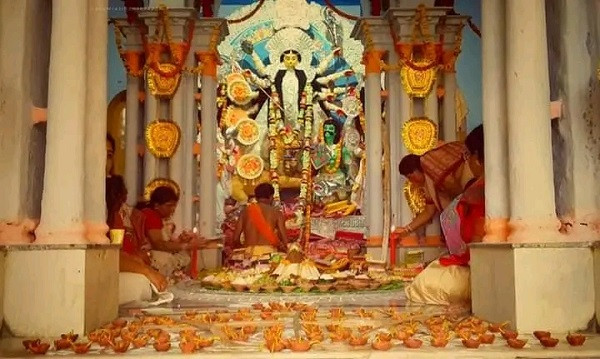
The family’s ancestral residence stands beside the sacred Ganga, whose autumn breeze brings the unmistakable signs of Durga Puja to its spacious Thakur Dalan, or traditional courtyard shrine. The fragrance of shiuli flowers and the sight of white kash blossoms herald the arrival of the Goddess, drawing family members back home from different districts, neighbouring states and even foreign countries. Every year, the festival becomes an occasion for a long-awaited family reunion, bringing generations together under one roof.
The sprawling mansion adjoining the Thakur Dalan has its own fascinating history. Around 188 years ago, the family’s earlier residence was swallowed by the Ganga, prompting their ancestor and zamindar, Nafar Chandra Pal, to construct the present mansion. However, the origins of the family’s Durga Puja go back even further.
According to Swaroop Pal, a member of the family, the worship was initiated by Nafar Chandra’s father, Churamani Pal. Churamani served as the dewan, or administrative officer, of the Andul Raj family. Impressed by his work, the king rewarded him with ownership of a substantial tract of tax-free land and entrusted him with zamindari responsibilities in the surrounding areas. It was during this period that the family’s Durga Puja began.
The family’s fortunes subsequently expanded under Nafar Chandra Pal, who combined his responsibilities as a zamindar with his entrepreneurial ambitions. Known as N.C. Pal, he established a successful brick-making business, and the bricks produced by his enterprise earned a reputation that reportedly extended as far as Britain. The bricks were also used by the British during that period, adding to the family’s standing and influence.
It was under Nafar Chandra’s leadership that the Durga Puja at the Pal residence gained greater prominence. A visionary who wanted to ensure that future generations would never face financial difficulties in continuing the annual worship, he established a Debottar Estate dedicated to religious and charitable purposes. Funds continue to flow into the estate throughout the year from various business properties, helping finance the family’s Durga Puja even today.
The rituals at the Pal residence reflect the family’s commitment to preserving traditional practices. The idol of Goddess Durga is fashioned in the ekchala style, with all the deities placed together within a single decorative framework. The Goddess is adorned in traditional daker saaj, giving the idol its distinctive appearance. The image is crafted within the Thakur Dalan itself, preserving the customary atmosphere of the ancestral celebration.
The puja also brings together generations of priests, drummers and other participants whose families have remained associated with the rituals for years. Chandi Path, the recitation of sacred verses from the Chandi, begins on Mahalaya, marking the spiritual preparation for the arrival of the Goddess.
The family follows the Vaishnav tradition, and animal sacrifice is therefore not part of its worship. During Sandhi Puja, 108 earthen lamps are lit as part of the sacred observance. The Goddess is offered homemade sweets, including bonde, along with other traditional delicacies prepared for the occasion.
Yet the most striking feature of the Pal family’s Durga Puja remains the early observance of Sindur Khela. Unlike the customary practice across Bengal, where married women celebrate the ritual on Dashami before the Goddess’s immersion, the women of this household gather for the ceremony on Ashtami. The reason is rooted in a tragedy that left an indelible mark on the family.
The family’s account, one of their ancestors died at the age of just 18 on the day of Ashtami. The young man’s untimely death plunged the household into profound grief. However, the family was determined that the worship of Goddess Durga should not be interrupted. In an extraordinary decision, the rituals were completed even as the deceased family member’s body remained at the residence. Sindur Khela and the other prescribed ceremonies were performed, and the idol was immersed on Ashtami itself.
From that day onwards, the family began observing Sindur Khela on Ashtami rather than Dashami. What began as a response to an unbearable personal tragedy gradually became a defining tradition of the ancestral puja, passed down from one generation to the next.
Today, the ceremony brings together not only members of the Pal family but also married women from the surrounding village and places farther away. They join the ritual, sharing in a tradition that combines the joy of devotion with the poignant remembrance of a young life lost too soon.
The Durga Puja at Rajganj’s Pal residence is therefore more than an annual religious celebration. It is a living record of Bengal’s zamindari heritage, ancestral devotion and the emotional histories that shape family traditions. Nearly two centuries after the puja began, its distinctive customs continue to survive, sustained by the determination of successive generations.
The elders of the family are also making efforts to familiarise younger members with the traditional rituals and their historical significance. Their aim is to ensure that the customs are not merely repeated but understood and cherished by those who will carry them forward.
At Rajganj, the arrival of Durga brings together relatives scattered across distances, fills the ancestral courtyard with the sounds of worship and revives memories of the past. But when Sindur Khela takes place on Ashtami, the celebration also recalls the family’s enduring sorrow. In this unique tradition, devotion and grief remain inseparable, preserving a remarkable chapter of Howrah’s cultural and religious heritage.
You might also like!