Balancing Act in West Asia: Narendra Modi’s Israel Visit Strengthens Strategic Ties but Raises Questions on Palestine
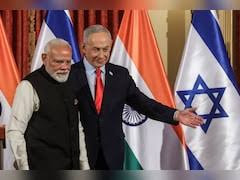
IIE DIGITAL DESK : Prime Minister Narendra Modi’s recent 24 hour visit to Jerusalem marked a high visibility diplomatic engagement with Israel, underscoring the deepening partnership between the two nations. Yet, while the visit signalled an expansion of bilateral cooperation, it has also triggered debate over whether India’s carefully calibrated balance in West Asia could face new strains, particularly regarding its long standing support for the Palestinian cause.
The visit, announced earlier by Israeli Prime Minister Benjamin Netanyahu, was marked by extraordinary personal warmth and symbolism. From the moment Mr. Modi landed in Jerusalem until his departure, Mr. Netanyahu personally accompanied him to engagements, reflecting Israel’s strong interest in projecting the visit as a diplomatic milestone. Following bilateral talks, the two leaders upgraded ties to a Special Strategic Partnership and signed more than 15 Memorandums of Understanding spanning artificial intelligence, agriculture, culture, education and critical technologies. A significant agreement was also reached to facilitate the employment of 50,000 Indian workers in Israel over the next five years, expanding labour mobility cooperation.
Observers noted that the intensity of the engagement appeared even stronger than during Mr. Modi’s 2017 visit, which had been historic as the first standalone visit by an Indian Prime Minister to Israel. The current visit, however, comes at a particularly sensitive time for Israel. The country has faced mounting international criticism over the humanitarian toll in Gaza following the October 2023 attacks by Hamas and Israel’s subsequent military response. Rising civilian casualties and controversial settlement proposals in the West Bank have led to sharp condemnation from several nations, including Germany, France and the United Kingdom, which had previously adopted more measured positions.
Against this backdrop, Mr. Netanyahu, who faces elections later this year amid allegations of corruption and scrutiny over security lapses in 2023, stands to gain politically from high profile international endorsements. Mr. Modi’s visit, with its visible display of camaraderie, may be interpreted domestically within Israel as a diplomatic boost for the Israeli leadership.
Mr. Modi expressed solidarity with victims of the October 2023 terror attack and acknowledged the shared pain of lives lost. However, he made only indirect reference to Palestinian sovereignty, stating that the U.S. led Gaza Peace Initiative, which envisions a two state solution, holds the promise of a just and durable peace by addressing the Palestine issue. Notably absent was any direct mention of the heavy civilian toll in Gaza since the conflict escalated, a point that has drawn attention from sections of the international community.
India has historically supported a two state solution, maintaining close ties with both Israel and Palestine while preserving strong political and economic relations with Arab countries across West Asia. The delicate balance has allowed New Delhi to expand defence, technology and agricultural cooperation with Israel without compromising energy security, diaspora interests and strategic partnerships in the Gulf.
Analysts suggest that a follow up visit to Palestine, similar to Mr. Modi’s outreach after his 2017 Israel trip, could help clarify India’s position and reaffirm its commitment to a negotiated settlement. The timing of the Jerusalem visit also coincided with heightened regional tensions, including speculation about potential U.S. military actions involving Iran. Travelling during such uncertainty carried the implicit risk of being perceived as aligning too closely with one side in an increasingly polarised environment.
Beyond the immediate bilateral outcomes, the broader regional implications of the visit will be closely watched. Mr. Modi announced renewed momentum for groupings such as the India Israel UAE framework and the expanded India Israel UAE United States partnership known as I2U2. He also reiterated support for the India Middle East Europe Economic Corridor, or IMEC, a connectivity initiative designed to link South Asia with Europe through the Gulf and Israel. These projects aim to strengthen economic integration and infrastructure cooperation, yet their feasibility depends heavily on regional stability and mutual trust.
The challenge lies in sustaining its strategic engagement with Israel while avoiding perceptions of abandoning its traditional emphasis on peace, morality and compassion in the Israel Palestine conflict. West Asian powers that share longstanding partnerships with India expect New Delhi to remain steadfast in its balanced diplomacy and independent foreign policy.
As India seeks to expand its global influence and economic footprint, its actions in sensitive geopolitical theatres carry amplified consequences. Mr. Modi’s Israel visit has undoubtedly advanced technological and strategic cooperation, but its lasting impact will depend on how effectively India navigates the intricate political landscape of West Asia. Maintaining equilibrium between strategic interests and principled diplomacy will be essential to preserving India’s credibility and relationships across the region.
You might also like!