India and South Korea Have Complementarities in Many Areas, from “Ships to Chips”: S. Jaishankar
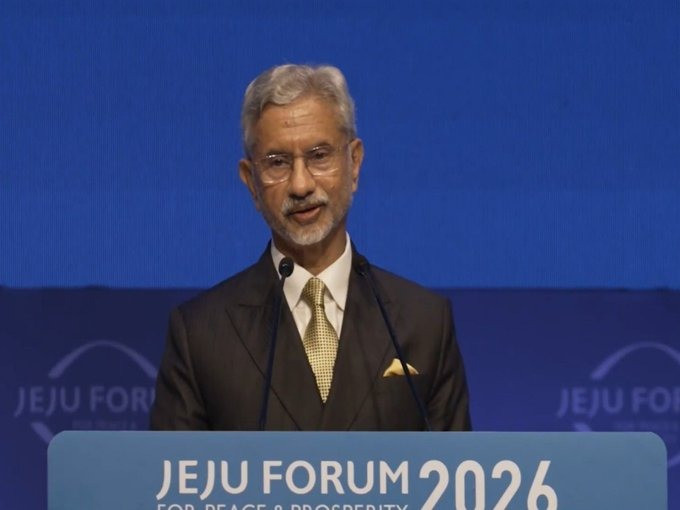
IIE DIGITAL DESK , June 25: India’s External Affairs Minister S. Jaishankar highlighted the growing strategic and economic partnership between India and South Korea, stating that the two nations possess significant complementarities across a wide range of sectors, stretching “from ships to chips.” Speaking at the 2026 Jeju Forum for Peace and Prosperity in South Korea on Thursday, Jaishankar emphasized that deeper cooperation between like-minded countries is essential in an increasingly fragmented and uncertain global landscape.
International audience at the prestigious forum, Jaishankar reflected on the theme of the event, which focused on redefining a fragmented world as a challenge and cooperation as the solution. He expressed broad agreement with the forum’s central premise but argued that global fragmentation is likely to remain a long-term reality and should not necessarily be viewed entirely in negative terms.
The minister, the current transformation of the global order has created opportunities alongside challenges. He noted that fragmentation can sometimes reduce dominance by a few powerful actors, create greater strategic space for emerging nations, and contribute to a more democratic distribution of influence across the international system. While acknowledging the concerns associated with a divided world, he suggested that the evolving global landscape could also empower countries to pursue more balanced and diversified partnerships.
Jaishankar urged policymakers and global leaders to examine the consequences of fragmentation through three critical questions: whether it undermines efficiency, whether it weakens stability, and whether it threatens security. He stated that even when fragmentation creates such challenges, the answer lies not in isolation but in stronger international cooperation. In his view, countries must work together more closely to address common concerns and build resilient frameworks capable of managing uncertainty.
The External Affairs Minister pointed to the India–South Korea relationship as an example of how complementary strengths can drive mutually beneficial cooperation. He observed that both nations possess capabilities that align across numerous sectors, ranging from traditional industries such as shipbuilding to advanced technology sectors including semiconductors. The phrase “from ships to chips,” he remarked, captures the breadth of opportunities available to both countries as they seek to expand economic engagement, technological collaboration, and strategic ties.
Jaishankar also spoke about India’s long-standing civilizational philosophy of global harmony. Referring to the ancient Indian concept of “Vasudhaiva Kutumbakam,” which translates to “the world is one family,” he said that India continues to draw inspiration from this belief in its approach to international relations. He noted that many of the conflicts and disruptions visible around the world today arise when forces within societies challenge the principles of coexistence, mutual respect, and collective responsibility.
The minister, the growing instability witnessed across regions underscores the need to reinforce values that encourage cooperation rather than confrontation. He argued that nations should strive to build partnerships based on trust, shared interests, and respect for diversity, especially at a time when geopolitical tensions and economic uncertainties are reshaping global affairs.
The Jeju Forum for Peace and Prosperity, one of Asia’s leading platforms for dialogue on international issues, brought together policymakers, diplomats, academics, and business leaders from across the world. Jaishankar’s remarks highlighted India’s commitment to fostering stronger partnerships in the Indo-Pacific region and reinforced the importance New Delhi places on its relationship with South Korea.
Both countries continue to expand collaboration in trade, technology, manufacturing, defense, and innovation, Jaishankar’s comments underscored the belief that deeper cooperation between India and South Korea can contribute not only to their mutual growth but also to broader regional stability and prosperity in an increasingly complex world.
You might also like!