Border Fencing Plan in Hingalganj Sparks Concern Among Ichhamati River Residents
IIE DIGITAL DESK ; North 24 Parganas, August 26: Uncertainty and concern are growing among residents, traders and fishermen living along the Ichhamati River in West Bengal’s Hingalganj area following a proposal to construct barbed-wire fencing along the India-Bangladesh border from Hingalganj to Shamshernagar. While local people have acknowledged the importance of strengthening border security, they fear that the proposed land acquisition could affect homes, businesses and livelihoods that have developed along the riverbank over generations.
According to local sources, a plan to acquire around 150 feet of land from the bank of the Ichhamati River in Hingalganj could directly affect a large number of villages spread across eight gram panchayats. The possibility of land acquisition has triggered particular anxiety among families whose livelihoods are closely linked to the river and the surrounding commercial activities.
Fishermen and people engaged in river-dependent occupations fear that restrictions and construction related to the proposed fencing could disrupt their traditional sources of income. Traders operating in the area are also concerned that the acquisition of land could affect established shops and commercial establishments, potentially putting the economic stability of many families at risk.
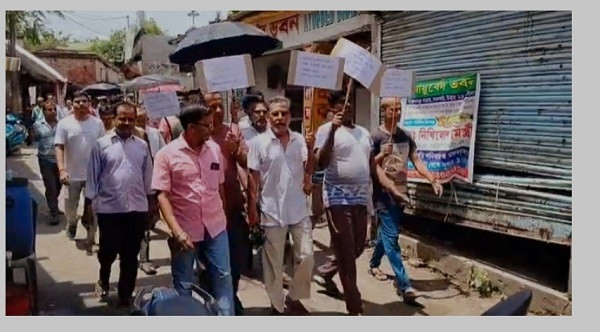
Against this backdrop, more than a hundred local residents and traders from areas along the Ichhamati River took part in a protest march on Tuesday. Carrying placards, festoons and banners, the protesters marched through the area and eventually reached the Hingalganj Block Development Office. The demonstration was led by local businessman Sushanta Ghosh.
Following the protest, representatives of the residents and traders submitted a memorandum to Hingalganj BDO Debidas Gangopadhyay. Through the memorandum, they sought the administration’s attention to the concerns of people who could potentially be affected by the proposed acquisition.
The protesters made it clear that they were not opposed to strengthening security along the international border. They acknowledged that safeguarding the country’s borders is an important responsibility and said they understood the need for effective security arrangements along the India-Bangladesh frontier.
However, they stressed that border security measures should be implemented without unnecessarily jeopardising the homes and livelihoods of local communities. They urged the administration to carefully assess the possible impact of land acquisition before taking any final decision and to ensure that affected residents are not left without adequate protection for their homes, businesses and sources of income.
The issue has assumed particular importance because of the long-standing economic and social history of the region. Local residents claim that the area has had a strong tradition of trade and commerce dating back to the period of undivided Bengal. According to them, commercial activities in the region expanded significantly from around 1783, creating a long-established economic network along the river and its surrounding areas.
Residents fear that large-scale land acquisition could therefore affect not only individual households but also long-standing commercial infrastructure. Small businesses, shops and other establishments that have developed over decades could face displacement if the proposed fencing requires substantial land along the riverbank.
For fishing communities, the concern is equally serious. Many families in the area depend directly or indirectly on the Ichhamati River for their livelihood. Any change in access to the riverbank or restrictions introduced during and after the construction of the border fencing could have a direct impact on fishing activities and associated occupations.
The proposed project has consequently created a delicate situation in the border region, where the demands of national security intersect with the everyday economic realities of local communities. Residents are seeking a solution that would allow the authorities to strengthen border protection while ensuring that people who have lived and worked in the area for generations are not disproportionately affected.
Local people have reiterated that their demand is not for the abandonment of border security measures but for a balanced and sensitive approach to their implementation. They want the administration to take into account the location of houses, shops, traditional occupations and other livelihood-related activities before finalising any land acquisition plan.
The residents have also called for meaningful consultation with affected communities so that their concerns can be properly assessed. They believe that a transparent process would help prevent further uncertainty and allow both security requirements and public interests to be addressed.
As discussions over the proposed fencing continue, attention is now focused on how the administration responds to the memorandum submitted by the protesters. For the people living along the Ichhamati, the central concern remains clear: the country’s borders must be protected, but the security of the nation should also be accompanied by safeguards for the homes, livelihoods and economic interests of the communities living on the frontier.
The proposed fencing from Hingalganj to Shamshernagar has therefore become more than a border-security issue for local residents. It has emerged as a question of balancing national security with the rights and livelihoods of people whose lives and economic activities have long been connected to the Ichhamati River.
You might also like!